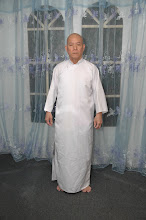
Singapore time 8.30 am 13th April 2008
Chapter 7
"I am illiterate," he replied, "but if you wish to know the purport of this work, please ask." "How can you grasp the meaning of the text," she rejoined, "when you do not even know the words?" To this he replied, "The profundity of the teachings of the various Buddha has nothing to do with the written language."
You should therefore accept the interpretation that Buddha-knowledge is the Buddha-knowledge of your own mind and not that of any other Buddha.
"I advice people constantly to open their eyes for the Buddha-knowledge within their mind.
if an ordinary man realises his own mind, he is said to have attained the Buddha-knowledge.
Chapter 8
"The teaching of your master," replied the Patriarch, "is for the followers of the Mahayana School, while mine is for those of the Supreme School. The fact that some realize the Dharma more quickly and deeply than others accounts for the difference in the interpretation. You may listen, and see if my instruction is the same as his. In expounding the Law, I do not deviate from the authority of the Essence of Mind (i.e., I speak what I realize intuitively). To speak otherwise would indicate that the speaker's Essence of Mind is under obscuration and that he can touch the phenomenal side of the Law only. The true teaching of Sila, Dhyana and Prajna should be based on the principle that the function of all things derives from the Essence of Mind. Listen to my stanza:
To free the mind from all impurity is the Sila of the Essence of Mind.
To free the mind from all disturbance is the Dhyana of the Essence of Mind.
That which neither increases nor decreases is the Diamond (used as a symbol for the Essence of Mind);
'Coming' and 'going' are different phases of Samadhi."
The 'self' is nothing but a phantasm created by the union of five skandhas,
And a phantasm can have nothing to do with absolute reality.
To hold that there is a Tathata (Suchness) for us to aim at or to return to
Is another example of 'Impure Dharma'.
Approving what he said in his stanza, the Patriarch said to him again, "The teaching of your master on Sila, Dhyana and Prajna applies to wise men of the inferior type, while mine [applies] to those of the superior type. He who realizes the Essence of Mind may dispense with such doctrines as Bodhi, Nirvana, and 'Knowledge of Emancipation'. Only those who do not possess a single system of Law can formulate all systems of Law, and only those who can understand the meaning (of this paradox) may use such terms. It makes no difference to those who have realized the Essence of Mind whether they formulate all systems of Law or dispense with all of them. They are at liberty to 'come' or to 'go' (i.e., they may remain in or leave this world at their own free will). They are free from obstacles or impediments. They take appropriate actions as circumstances require. They give suitable answers according to the temperament of the enquirer. They see that all Nirmanakayas are one with the Essence of Mind.
"They attain liberation, psychic powers and Samadhi, which enable them to perform the arduous task of universal salvation as easily as if they were only playing. Such are the men who have realized the Essence of Mind!"
Sunday, 13 April 2008


Saturday, 12 April 2008
Quotation From Hui Neng
Singapore time 9.05 am 12th April 2008
Chapter 9
"The Norm is to be realized by the mind," replied the Patriarch, "and does not depend on the sitting position. The Diamond Sutra says that it is wrong for anyone to assert that the Tathagata comes or goes, sits or reclines. Why? Because the Tathagata's 'Dhyana of Purity' implies neither coming from anywhere nor going to anywhere, neither becoming nor causing to be. All Dharmas are calm and void, and such is the Tathagata's 'Seat of Purity'. Strictly speaking, there is even no such thing as 'attainment'; why then should we bother ourselves about the sitting position?"
"From the point of view of ordinary men," replied the Patriarch, "enlightenment and ignorance are two separate things. Wise men who realize thoroughly the Essence of Mind know that they are of the same nature. This same nature or non-dual nature is what is called the 'real nature', which neither decreases in the case of ordinary men and ignorant persons, nor increases in the case of the enlightened sage; which is not disturbed in a state of annoyance, nor calm in a state of Samadhi. It is neither eternal nor non-eternal; it neither goes nor comes; it is not to be found in the exterior, nor in the interior, nor in the space between the two. It is above existence and non-existence; its nature and its phenomena are always in a state of 'Thusness'; it is permanent and immutable. Such is the Norm."
"In the teaching of the heretics," replied the Patriarch, "'nonexistence' means the end of 'existence', while 'existence' is used in contrast with 'non-existence'. What they mean by 'non-existence' is not actually annihilation and what they call 'existence' does not really exist. What I mean by 'above existence and non-existence' is this; intrinsically it exists not, and at the present moment it will not be annihilated. Such is the difference between my teaching and that of the heretics.
"If you wish to know the essential points of my teaching, you should free yourself from all thoughts, good ones as well as bad; then your mind will be in a state of purity, calm and serene all the time, and its usefulness as manifold as the grains of sand in the Ganges."
Chapter 10
"From the Buddha Sakyamuni, the Law was transmitted to the: 1st Patriarch Arya Mahakasyapa 2nd Patriarch Arya Ananda 3rd Patriarch Arya Sanakavasa 4th Patriarch Arya Upagupta 5th Patriarch Arya Dhritaka 6th Patriarch Arya Michaka 7th Patriarch Arya Vasumitra 8th Patriarch Arya Buddhanandi 9th Patriarch Arya Buddhamitra 10th Patriarch Arya Parsva 11th Patriarch Arya Punyayasas 12th Patriarch Bodhisattva Asvaghosa 13th Patriarch Arya Kapimala 14th Patriarch Bodhisattva Nagarjuna 15th Patriarch Kanadeva 16th Patriarch Arya Rahulata 17th Patriarch Arya Sanghanandi 18th Patriarch Arya Gayasata 19th Patriarch Arya Kumarata 20th Patriarch Arya Jayata 21st Patriarch Arya Vasubandhu 22nd Patriarch Arya Manorhita 23rd Patriarch Arya Haklenayasas 24th Patriarch Arya Simha 25th Patriarch Arya Basiasita 26th Patriarch Arya Punyamitra 27th Patriarch Arya Prajnatara 28th Patriarch Arya Bodhidharma (the first Patriarch in China) 29th Patriarch Grand Master Hui K'u 30th Patriarch Grand Master Seng Ts'an 31st Patriarch Grand Master Tao Hsin 32nd Patriarch Grand Master Hung Yen And I am the 33rd Patriarch (the sixth Patriarch in China). Thus the Dharma was handed down from one Patriarch to another. Hereafter, you men should in turn transmit it to posterity, from one generation to another, so that the tradition may be maintained."
Transmission of the Dharma was from one master to another in the past before Hui Neng. His passing of Dharma was to many. It stated he transmitted to 43 monks/nuns. This transmission is what Heavenly Way group is transmitting. That is to Seal the Mark on your forehead.
Buddha-seeds latent in our mind
Will sprout upon the coming of the all pervading rain.
The flower of the doctrine having been intuitively grasped,
One is bound to reap the fruit of Enlightenment.
Then he added, "The Dharma is non-dual and so is the mind. The Path is pure and above all forms. I warn you not to use those exercises for meditation on quietude or for keeping the mind a blank. The mind is by nature pure, so there is nothing for us to crave for or give up. Do your best, each of you, and go wherever circumstances lead."
"Within our mind there is a Buddha, and that Buddha within is the real Buddha.
So must you pray to Buddha made of wood, metal, stones, cloth, paper etc ?
He who is able to realize the Truth within his own mind
Has sown the seed of Buddhahood.
Imperturbable and serene, the ideal man practices no virtue.
Self-possessed and dispassionate, he commits no sin.
Calm and silent, he gives up seeing and hearing.
Even and upright, his mind abides nowhere.
Thursday, 10 April 2008
Re-incarnated Elijah
Singapore time 8.43 am 10th April 2008
Malachi -
4:1 For, behold, the day cometh, that shall burn as an oven; and all the proud, yea, and all that do wickedly, shall be stubble: and the day that cometh shall burn them up, saith the LORD of hosts, that it shall leave them neither root nor branch.
4:2 But unto you that fear my name shall the Sun of righteousness arise with healing in his wings; and ye shall go forth, and grow up as calves of the stall.
4:3 And ye shall tread down the wicked; for they shall be ashes under the soles of your feet in the day that I shall do this, saith the LORD of hosts.
4:4 Remember ye the law of Moses my servant, which I commanded unto him in Horeb for all Israel, with the statutes and judgments.
4:5 Behold, I will send you Elijah the prophet before the coming of the great and dreadful day of the LORD:
4:6 And he shall turn the heart of the fathers to the children, and the heart of the children to their fathers [this is Confucianism], lest I come and smite the earth with a curse.
This chapter tells that Elijah will come down. His main duty is to gather union of family. So divorced people, you have to contemplate your action. And those on the brink of divorce, you have to think twice before embarking for divorce.
Jesus had said that if you divorce your wife other than her adultery reason, and marry another woman, you are committing adultery.
I champion family unity as per Confucianism. Cultivate self, regulate family, cure the country, then bring world peace is the main theme of Confucianism. Regulate family is to unite you family with you. If there is no other man preaching the unity of family, it is possible I am the re-incarnated Elijah.
Sunday, 6 April 2008
Quotation From Zhuangzi
Singapore time 8.37 am 6th April 2008
Chapter 1
In the northern ocean there is a fish, called the Leviathan, many thousand li in size. This leviathan changes into a bird, called the Rukh, whose back is many thousand li in breadth. With a mighty effort it rises, and its wings obscure the sky like clouds (Scriptures like to describe nose as fish, eye-brows as bird.)
It was on this very subject that the Emperor T'ang spoke to Chi, as follows:- "At the barren north there is a great sea, the Celestial Lake. In it there is a great fish, several thousand li in breadth, and I know not how many in length. It is called the Leviathan. There is also a bird, called the Rukh, with a back like Mount T'ai, and wings like clouds across the sky. Upon a typhoon it soars up to a height of 90 thousand li, beyond the clouds and atmosphere, with only the clear sky above it. And then it directs its flight towards the south pole."
Thus it has been said, "The perfect man ignores self; the divine man ignores action; the true Sage ignores reputation."
Chapter 2
"Therefore it is that, viewed from the standpoint of Tao, a beam and a pillar are identical. So are ugliness and beauty, greatness, wickedness, perverseness, and strangeness. Separation is the same as construction: construction is the same as destruction. Nothing is subject either to construction or to destruction, for these conditions are brought together into ONE. Only the truly intelligent understand this principle of the identity of all things. They do not view things as apprehended by themselves, subjectively; but transfer themselves into the position of the things viewed. And viewing them thus they are able to comprehend them, nay, to master them;- and he who can master them is near. So it is that to place oneself in subjective relation with externals, without consciousness of their objectivity,- this is Tao. But to wear out one's intellect in an obstinate adherence to the individuality of things, not recognizing the fact that all things are ONE,- this is called Three in the Morning." [three are two eyes and the Mark in between, the same as Jesus crucified between 2 thieves or Amita Buddha flanked by 2 Bodhisattvas.]
Chapter 3
In striving for others, avoid fame. In striving for self, avoid disgrace. Pursue a middle course. Thus you will keep a sound body, and a sound mind, fulfill your duties, and work out your allotted span. (Meditate with a mind thinking neither good nor evil is the Middle Path. Another is focus on the point in between our 2 eyes. On your daily life thread the middle path of all extremes, like high and low, front and back, good and evil, fast and slow, happy and sad, honour and disgrace etc etc.
The Master came, because it was his time to be born; he went, because it was his time to die. For those who accept the phenomenon of birth and death in this sense, lamentation and sorrow have no place. The ancients spoke of death as of God cutting down a man suspended in the air." (Spiritual masters do not cry over death of kins or friends. Funeral is actually a waste of money and time.)
Chapter 4
"In this sense, you may use your ears and eyes to communicate within, but shut out all wisdom from the mind. (instruction for meditation) And there where the supernatural can find shelter, shall not man find shelter too? This is the method for regenerating all creation. It was the instrument which Yu and Shun employed. It was the secret of the success of Fu Hsi and Chi Chu. Shall it not then be adopted by mankind in general?" (The dialogue tells us Taoists can mediate in politics if we know the means. Also here it says of the secret of meditation that is to regenerate the body.)
To serve one's own heart so as to permit neither joy nor sorrow within, but to cultivate resignation to the inevitable,- this is the climax of Virtue. (meditate and leave the rest to fate. Destiny is fate, Duty in Chinese is Righteousness.)
"Ah!," said Tzu Ch'i. "This tree is good for nothing, and that is how it has attained this size. A wise man might well follow its example."
Chapter 5
"By nourishment of physical courage, the sense of fear may be so eliminated that a man will, single-handedly, brave a whole army. And if such a result can be achieved in search of fame, how much more by one who extends his sway over heaven and earth and influences all things; and who, lodging within the confines of a body with its channels of sight and sound, brings his knowledge to know that all things are ONE, and that his soul endures for ever! Besides, he awaits his appointed hour, and men flock to him of their own accord. He makes no effort to attract them."
Thus it is that virtue should prevail and outward form be forgotten. But mankind forgets not that which is to be forgotten, forgetting that which is not to be forgotten. This is forgetfulness indeed! And thus with the truly wise, wisdom is a curse, sincerity like glue, virtue only a means to acquire, and skill nothing more than a commercial capacity. For the truly wise make no plans, and therefore require no wisdom. They do not separate, and therefore require no glue. They want nothing, and therefore need no virtue. They sell nothing, and therefore are not in want of a commercial capacity. These 4 qualifications are bestowed upon them by God and serve as heavenly food to them. And those who thus feed upon the divine have little need for the human. They wear the forms of men, without human passions. Because they wear the forms of men, they associate with men. Because they have not human passions, positives and negatives find in them no place. Infinitesimal indeed is that which makes them man: infinitely great is that which makes them divine!
"What you mean by passions," answered Chuang Tzu, "is not what I mean. By a man without passions I mean one who does not permit good and evil to disturb his internal economy, but rather falls in with whatever happens, as a matter of course, and does not add to the sum of his mortality." (During meditation think neither good nor bad things. Maintain this at all time during walking, sleeping, talking etc)
Quotation From Zhuangzi
Singapore time 8.24 am 6th April 2008
Chapter 6
He who knows what God is, and who knows what Man is, has attained. Knowing what God is, he knows that he himself proceeded there from. Knowing what Man is, he rests in the knowledge of the known, waiting for the knowledge of the unknown. Working out one's allotted span, and not perishing in mid career,- this is the fullness of knowledge. (God [sky] is mentioned again instead of Tao. Ask yourself, what is God? Is it Tao?)
The pure men of old did not know what it was to love life or to hate death. They did not rejoice in birth, nor strive to put off dissolution. Quickly come, and quickly go;- no more. They did not forget whence it was they had sprung, neither did they seek to hasten their return thither. Cheerfully they played their allotted parts, waiting patiently for the end. This is what is called not to lead the heart astray from Tao, nor to let the human seek to supplement the divine. And this is what is meant by a pure man.
Such men are in mind absolutely free; in demeanor, grave; in expression, cheerful. If it is freezing cold, it seems to them like autumn; if blazing hot, like spring. Their passions occur like the 4 seasons. They are in harmony with all creation, and none know the limit thereof. And so it is that a perfect man can destroy a kingdom and yet not lose the hearts of the people, while the benefits he hands down to 10 thousand generations do not proceed from love of his fellowman.
He who delights in man, is himself not a perfect man. His affection is not true charity. Depending upon opportunity, he has not true worth. He who is not conversant with both good and evil is not a superior man. He who disregards his reputation is not what a man should be. He who is not absolutely oblivious of his own existence can never be a ruler of men.
For what they cared for could be reduced to ONE, and what they did not care for to ONE also. That which was ONE was ONE, and that which was not ONE was likewise ONE. In that which was ONE, they were of God; in that which was not ONE, they were of Man. And so between the human and the divine no conflict ensued. This was to be a pure man.
Life and Death belong to Destiny. Their sequence, like day and night, is of God, beyond the interference of man, an inevitable law. A man looks upon God as upon his father, and loves him in like measure. Shall he then not love that which is greater than God? (Destiny is Fate. The Tao in us is greater than other Tao. Know the Son then you will know the Father.)
Tao has its laws, and its evidences. It is devoid both of action and of form. It may be transmitted, but cannot be received. It may be obtained, but cannot be seen. Before heaven and earth were, Tao was. It has existed without change from all time. Spiritual beings drew their spirituality there from, while the universe became what we can see it now. To Tao, the zenith is not high, nor the nadir low; no point in time is long ago, nor by lapse of ages has it grown old.
"I fear not," said Nu Yu. "You are not the sort of man. There was Pu Liang I. He had all the qualifications of a sage, but not Tao. Now I had Tao, though none of the qualifications. But do you imagine that much as I wished it I was able to teach Tao to him so that he should be a perfect sage? Had it been so, then to teach Tao to one who has the qualifications of a sage would be an easy matter. No, Sir. I imparted as though withholding; and in 3 days, for him, this sublunary state had ceased to exist. When he had attained to this, I withheld again; and in 7 days more, for him, the external world had ceased to be. And so again for another 9 days, when he had became unconscious of his own existence. He became first ethereal, next possessed of perfect wisdom, then without past or present, and finally able to enter there where life and death are no more,- where killing does not take away life, not does prolongation of life add to the duration of existence. In that state, he is ever in accord with the exigencies of his environment; and this is to be Battered but not Bruised. And he who can be thus battered but not bruised is on the way to perfection."
"These men," replied Confucius, "travel beyond the rule of life. I travel within it. Consequently, our paths do not meet; and I was wrong in sending you to mourn. They consider themselves as one with God, recognizing no distinctions between human and divine. They look on life as a huge tumor from which death sets them free. All the same they know not where they were before birth, nor where they will be after death. Though admitting different elements, they take their stand upon the unity of all things. They ignore their passions. They take no count of their ears and eyes. Backwards and forwards through all eternity, they do not admit a beginning or end. They stroll beyond the dust and dirt of mortality, to wander in the realms of inaction. How should such men trouble themselves with the conventionalities of this world, or care what people may think of them?"
"Ah!" replied Hsu Yu, "that cannot be known. But I will give you an outline. The Master I serve succors all things, and does not account it duty. He continues his blessings through countless generations, and does not account it charity. Dating back to the remotest antiquity, he does not account himself old. Covering heaven, supporting earth, and fashioning the various forms of things, he does not account himself skilled. He it is whom you should seek." (The Master is Your Spiritual Soul, son of the Universal Tao.)
Chapter 7
"That is a false teaching indeed," replied Chieh Yu. "To attempt to govern mankind thus,--as well try to wade through the sea, to hew a passage through a river, or make a mosquito to fly away with a mountain! The government of the truly wise man has no concern with externals. He first perfects himself, and then by virtue thereof he is enabled to accomplish what he wants. The bird flies high to avoid snare and dart, the mouse burrows down below the hill to avoid being smoked or cut out of its nest. Is your wit below that of these 2 creatures?"
But T'ien Ken enquired a second time, and the Sage replied, "Resolve your mental energy into abstraction, your physical energy into inaction. Allow yourself to fall in with the natural order of phenomena, without admitting the element of self,--and the empire will be governed." (meditation- by regulating oneself by meditation, the king is bringing good fortune to the country.)
"The goodness of a wise ruler," answered Lao Tzu, "covers the whole empire, yet he himself seems to know it not. It influences all creation, yet none is conscious thereof. It appears under countless forms, bringing joy to all things. It is based upon the baseless, and travels through the realms of Nowhere." (Lao Tzu had no better answer than to mention Tao. He was giving instruction in inaction.)
Lieh Tzu went in and wept bitterly, and told Hu Tzu; but the latter said, "I showed myself to him just now as the earth shows us its outward form, motionless and still, while production is all the time going on. I merely prevented him from seeing my pent-up energy within. Bring him again."
Lieh Tzu went in and told Hu Tzu; whereupon the latter replied, "I showed myself to him just now as heaven shows itself in all its dispassionate grandeur, letting a little energy run out of my heels. He was thus able to detect that I had some. Bring him here again."
This being repeated to Hu Tzu as before, the latter said, "I showed myself to him just now in a state of harmonious equilibrium. Where the whale disports itself,--is the abyss. Where water is at rest,--is the abyss. Where water is in motion,--is the abyss. The abyss has nine names. These are 3 of them."
"I showed myself to him just now," said Hu Tzu, "as Tao appeared before time was. I was to him as a great blank, existing of itself. He knew not who I was. His face fell. He became confused. And so he fled." (Display of 4 states of Tao.)
Upon this Lieh Tzu stood convinced that he had not yet acquired any real knowledge, and at once set to work in earnest, passing 3 years without leaving the house. He helped his wife to cook the family dinner, and fed his pigs just like human beings. He discarded the artificial and reverted to the natural. He became merely a shape. Amidst confusion, he was un-confounded. And so he continued to the end. (Cultivating Tao should be like this. But don't rear animals and birds for food. Be vegetarian.)
By Inaction, fame comes as the spirits of the dead come to the boy who impersonates the corpse. By Inaction, one can become the center of thought, the focus of responsibility, the arbiter of wisdom. Full allowance must be made for others, while remaining unmoved oneself. There must be a thorough compliance with divine principles, without any manifestation thereof.
All of which may be summed up in the one word passivity. For the perfect man employs his mind as a mirror. It grasps nothing; it refuses nothing. It receives, but does not keep. And thus he can triumph over matter, without injury to himself.
Quotation From Zhuangzi
Singapore time 8.12 am 6th April 2008
Chapter 8
They are those who yield to the natural conditions of things. What I call perfection of hearing is not hearing others but oneself. What I call perfection of vision is not seeing others but oneself.
Chapter 11
By means of inaction he will be able to adapt himself to the natural conditions of existence. And so it is that he who respects the State as his own body is fit to support it, and he who loves the State as his own body, is fit to govern it. And if I can refrain from injuring my internal economy, and from taxing my powers of sight and hearing, sitting like a corpse while my dragon-power is manifested around, in profound silence while my thunder-voice resounds, the powers of heaven responding to every phase of my will, as under the yielding influence of inaction all things are brought to maturity and thrive,-- what leisure then have I to set about governing the world?
Chapter 12
Therefore it has been said, "As for those who nourished the empire of old, having no desires for themselves, the empire was not in want. They did nothing, and all things proceeded on their course. They preserved a dignified repose, and the people rested in peace."
The Record says, "By converging to ONE, all things may be accomplished. By the virtue which is without intention, even the supernatural may be subdued."
The Master said, "Tao covers and supports all things,"--so vast is its extent. Each man should prepare his heart accordingly. "To act by means of inaction is God. To speak by means of inaction is exemplification of Tao. To love men and care for things is charity. To recognize the unlike as the like is breadth of view. To make no distinctions is liberal. To possess variety is wealth. And so, to hold fast to virtue is strength. To complete virtue is establishment. To follow Tao is to be prepared. And not to run counter to the natural bias of things is to be perfect.
"He who fully realizes these 10 points, by storing them within enlarges his heart, and with this enlargement brings all creation to himself. Such a man will bury gold on the hillside and cast pearls into the sea. He will not struggle for wealth, nor strive for fame. He will not rejoice at old age, nor grieve over early death. He will find no pleasure in success, no chagrin in failure. He will not account a throne as his own private gain, nor the empire of the world as glory personal to himself. His glory is to know that all things are ONE, and that life and death are but phases of the same existence!"
At the beginning of beginning, even Nothing did not exist. Then came the period of the Nameless. When One came into existence, there was ONE, but it was formless. When things got that by which they came into existence, it was called their virtue. That which was formless, but divided, though without interstice, was called destiny.
Then came the movement which gave life, and things produced in accordance with the principles of life had what is called form. When form encloses the spiritual part, each with its own characteristics, that is its nature. By cultivating this nature, we are carried back to virtue; and if this is perfected, we become as all things were in the beginning. We become unconditioned, and the unconditioned is great. As birds join their beaks in chirping, and beaks to chirp must be joined,--to be thus joined with the universe without being more conscious of it than an idiot, this is divine virtue, this is accordance with the eternal fitness of things.
Cultivation of self is in his own hands. To be unconscious of objective existences and of God, this is to be unconscious of one's own personality. And he who is unconscious of his own personality, combines in himself the human and the divine."
In the Golden Age, good men were not appreciated; ability was not conspicuous. Rulers were mere beacons, while the people were free as the wild deer. They were upright without being conscious of duty to their neighbors. They loved one another without being conscious of charity. They were true without being conscious of loyalty. They were honest without being conscious of good faith. They acted freely an all things without recognizing obligations to any one. Thus, their deeds left no trace; their affairs were not handed down to posterity.
Chapter 13
The repose of the Sage is not what the world calls repose. His repose is the result of his mental attitude. All creation could not disturb his equilibrium: hence his repose.
When water is still, it is like a mirror, reflecting the beard and the eyebrows. It gives the accuracy of the water-level, and the philosopher makes it his model. And if water thus derives lucidity from stillness, how much more the faculties of the mind? The mind of the Sage being in repose becomes the mirror of the universe, the speculum of all creation.
Repose, tranquility, stillness, inaction,--these were the levels of the universe, the ultimate perfection of Tao.
Chuang Tzu said, "O my exemplar! Thou who destroyest all things, and dost not account it cruelty; thou who benefitest all time, and dost not account it charity; thou who art older than antiquity and dost not account it age; thou who supportest the universe, shaping the many forms therein, and dost not account it skill;--this is the happiness of God!"
Therefore it has been said, "Those who enjoy the happiness of God, when born into the world, are but fulfilling their divine functions; when they die, they do but undergo a physical change. In repose, they exert the influence of the Negative; in motion, they wield the power of the Positive."
For the action of the wise ruler is modeled upon the universe, is guided by Tao, and is ever occupied in inaction. By inaction, he administers the empire, and has energy to spare; but by action he finds his energy inadequate to the administration of the empire. Therefore the men of old set great store by inaction.
Rulers must practice inaction in order to administer the empire. The ruled must practice action in order to sub-serve the interests of the empire. This is an unchangeable law.
Men precede, women follow. Husbands precede, wives follow.
Some modern people might reject this especiaaly the women. Bible has similar one.
Saturday, 5 April 2008
Qyotation From Zhuangzi
Singapore time 8.47 am 5th April 2008
Chapter 14
"Just so," rejoined Lao Tzu. "Were Tao something which could be presented, there is no man but would present it to his sovereign, or to his parents. Could it be imparted or given, there is no man but would impart it to his brother or give it to his child. But this is impossible, for the following reason. Unless there is a suitable endowment within, Tao will not abide. Unless there is outward correctness, Tao will not operate. The external being unfitted for the impression of the internal, the true Sage does not seek to imprint. The internal being unfitted for the reception of the external, the true Sage does not seek to receive. Reputation is public property; you may not appropriate it in excess. Charity and duty to one's neighbor are as caravanserais established by wise rulers of old; you may stop there one night, but not for long, or you will incur reproach.
"The perfect men of old took their road through charity, stopping a night with duty to their neighbor, on their way to ramble in transcendental space. Feeding on the produce of non-cultivation, and establishing themselves in the domain of no obligations, they enjoyed their transcendental inaction. Their food was ready to hand; and being under no obligations to others, they did not put any one under obligation to themselves. The ancients called this the outward visible sign of an inward and spiritual grace.
"Those who make wealth their all in all, cannot bear loss of money. Those who make distinction their all in all, cannot bear loss of fame. Those who affect power will not place authority in the hands of others. Anxious while holding, distressed if losing, yet never taking warning from the past and seeing the folly of their pursuit,--such men are the accursed of God.
"Resentment, gratitude, taking, giving, censure of self, instruction of others, power of life and death,--these 8 are the instruments of right; but only he who can adapt himself to the vicissitudes of fortune, without being carried away, is fit to use them. Such a one is an upright man among the upright. And he whose heart is not so constituted,--the door of divine intelligence is not yet opened for him."
Nature cannot be changed. Destiny cannot be altered. Time cannot stop. Tao cannot be obstructed. Once attain to Tao, and there is nothing which you cannot accomplish. Without it, there is nothing which you can accomplish."
Chapter 15
But in self-esteem without self-conceit, in moral culture without charity and duty to one's neighbor, in government without rank and fame, in retirement without solitude, in health without hygiene,--there we have oblivion absolute coupled with possession of all things; an infinite calm which becomes an object to be attained by all.
Such is the Tao of the universe, such is the virtue of the Sage. Wherefore it has been said, "In tranquility, in stillness, in the unconditioned, in inaction, we find the levels of the universe, the very constitution of Tao."
Wherefore it has been said, "The Sage is a negative quantity, and is consequently in a state of passivity. Being passive he is in a state of repose. And where passivity and repose are, there sorrow and anxiety do not enter, and foul influences do not collect. And thus his virtue is complete and his spirituality unimpaired."
Wherefore it has been said, "The birth of the Sage is the will of God; his death is but a modification of existence. In repose, he shares the passivity of the Yin; in action, the energy of the Yang. He will have nothing to do with happiness, and so has nothing to do with misfortune. He must be influenced ere he will respond. He must be urged ere he will move. He must be compelled ere he will arise. Ignoring the future and the past, he resigns himself to the laws of God.
"And therefore no calamity comes upon him, nothing injures him, no man is against him, no spirit punishes him. He floats through life to rest in death. He has no anxiety; he makes no plans. His honor does not make him illustrious. His good faith reflects no credit upon himself. His sleep is dreamless, his awaking without pain. His spirituality is pure, and his soul vigorous. Thus unconditioned and in repose, he is a partaker of the virtue of God."
Wherefore it has been said, "Sorrow and happiness are the heresies of virtue; joy and anger lead astray from Tao; love and have cause the loss of virtue. The heart unconscious of sorrow and happiness,--that is perfect virtue. ONE, without change,--that is perfect repose. Without any obstruction,-- that is the perfection of the unconditioned. Holding no relations with the external world,--that is perfection of the negative state. Without blemish of any kind,--that is the perfection of purity."
Wherefore it has been said, "If the body toils without rest, it dies. If the mind is employed without ceasing, it becomes wearied; and being wearied, its power is gone."
Pure water is by nature clear. If untouched, it is smooth. If dammed, it will not flow, neither will it be clear. It is an emblem of the virtue of God. Wherefore it has been said, "Pure, without admixture; uniform, without change; negative, without action; moved , only at the will of God;--such would be the spirituality nourished according to Tao."
Chapter 16
Those of old who were called retired scholars, were not men who hid their bodies, or kept back their words, or concealed their wisdom. It was that the age was not suitable for their mission. If the age was suitable and their mission a success over the empire, they simply effaced themselves in the unity which prevailed. If the age was unsuitable and their mission a failure, they fell back upon their own resources and waited. Such is the way to preserve oneself.
Those of old who preserved themselves, did not ornament their knowledge with rhetoric. They did not exhaust the empire with their knowledge. They did not exhaust virtue. They kept quietly to their own spheres, and reverted to their natural instincts. What then was left for them to do?
Tao does not deal with detail. Virtue does not take cognizance of trifles. Trifles injure virtue; detail injures Tao. Wherefore it has been said, "Self-reformation is enough." He whose happiness is complete has attained his desire.
Of old, attainment of desire did not mean office. It meant that nothing could be added to the sum of happiness. But now it does mean office, though office is external and is not a part of oneself. That which is adventitious, comes. Coming [birth], you cannot prevent it; going [death or expire], you cannot arrest it. Therefore, not to look on office as the attainment of desire, and not because of poverty to become a toady, but to be equally happy under all conditions,-- this is to be without sorrow.
Subscribe to:
Posts (Atom)